Another recent set of combos played was all about the aliens that are used to being in charge.
DICTATOR [base] Controls Destiny Deck
EMPEROR [CE] Demands Tribute
GENERAL [CA] Draws Cards for Allies
OLIGARCH [CE] Gets Richer as Others Get Poorer
TYRANT [CS] Claims Other Players’ Ships
USURPER [CD] Makes Allies Play Encounter Cards
For additional players, consider adding in:
NANNY [CE] Motivates
SHERIFF [CE] Upholds The Law
Tuesday, July 4, 2017

Saturday, January 30, 2016
Cosmic Combos (part 1)
Over the last year, I've been able to set up some Cosmic Combos.
These are games where the aliens have been pre-selected to be in the same game.
Here are a few of the combos we've played, and some commentary.
8- Angler
We only ended up doing the six player mix, which includes Winner. However, if we'd gone to eight players, we decided that Loser was the obvious next alien to add in, and for giggles, Angler as the eighth player (who better to join a poker game than someone who prefers Go Fish?).
This was a very interesting mix of aliens to have in one game. Deuce and Tripler created high totals a lot, but the combination of Joker and Gambler also made for some hilarious interactions. Gambler would "bluff" that his card was whatever Joker declared to be wild (especially when they were allied, but also late in the game when all Joker had left were his high value tokens and was facing off against Gambler).
Ace, of course was the scapegoat alien, never invited as the offensive ally (and also rarely invited to defense either). He got his one colony, but lost it a few turns later.
Winner was on everyone's radar, but he managed to get the 40 and gain his fourth colony as defense, right before his turn. Winner and Deuce shared the win with Joker, Tripler, and Gambler at three colonies, and Ace at none.
These are games where the aliens have been pre-selected to be in the same game.
Here are a few of the combos we've played, and some commentary.
POKER FACE
1- Ace
2- Deuce
3- Tripler
4- Joker
5- Gambler
6- Winner
7- Loser8- Angler
We only ended up doing the six player mix, which includes Winner. However, if we'd gone to eight players, we decided that Loser was the obvious next alien to add in, and for giggles, Angler as the eighth player (who better to join a poker game than someone who prefers Go Fish?).
This was a very interesting mix of aliens to have in one game. Deuce and Tripler created high totals a lot, but the combination of Joker and Gambler also made for some hilarious interactions. Gambler would "bluff" that his card was whatever Joker declared to be wild (especially when they were allied, but also late in the game when all Joker had left were his high value tokens and was facing off against Gambler).
Ace, of course was the scapegoat alien, never invited as the offensive ally (and also rarely invited to defense either). He got his one colony, but lost it a few turns later.
Winner was on everyone's radar, but he managed to get the 40 and gain his fourth colony as defense, right before his turn. Winner and Deuce shared the win with Joker, Tripler, and Gambler at three colonies, and Ace at none.
Sunday, June 8, 2014
Cosmic Dominion in the Hyperspace Gate
The fifth expansion for CE has been announced, and will be available in a few months or so.
Cosmic Dominion is being touted as the "Fan Expansion", because it is largely composed of fan-designed content (aliens, cards, and more). It was also officially designed by three fans: Jefferson Krogh, Bill Martinson, and yours truly. The three of us shepherded the submissions, fine-tuned them, and quibbled vigorously over every detail.
The set will come with 30 aliens (the most of any FFG expansion for CE), and includes a few of the classic Eon aliens that had yet been unpublished in this edition. Some of the classic aliens (like Aristocrat) are largely unchanged, but a few have been re-imagined (most notably some of the remaining lucre aliens).
Having worked on the set, I can say that I am extremely pleased with how it's turned out, and it may be my new favorite expansion. Cosmic Incursion (the first expansion) was the old favorite, mostly because it contained my idea for the Reward Deck. But Cosmic Dominion has its own Reward Deck as well- with some new concepts, and some really amped-up versions of cards found in the original Reward Deck.
Cosmic appeals to a pretty wide range of fans- some like the straight-forward mechanics and effects, and some enjoy the wackier content. Dominion was designed to appeal to the whole spectrum of fan preferences. That said, there will be a few aliens that many fans will just shy away from (something that is probably true of any of the expansions). But I sincerely believe just about every fan of CE will love most of what's in the box.
I'll talk more about specific content soon.
Cosmic Dominion is being touted as the "Fan Expansion", because it is largely composed of fan-designed content (aliens, cards, and more). It was also officially designed by three fans: Jefferson Krogh, Bill Martinson, and yours truly. The three of us shepherded the submissions, fine-tuned them, and quibbled vigorously over every detail.
The set will come with 30 aliens (the most of any FFG expansion for CE), and includes a few of the classic Eon aliens that had yet been unpublished in this edition. Some of the classic aliens (like Aristocrat) are largely unchanged, but a few have been re-imagined (most notably some of the remaining lucre aliens).
Having worked on the set, I can say that I am extremely pleased with how it's turned out, and it may be my new favorite expansion. Cosmic Incursion (the first expansion) was the old favorite, mostly because it contained my idea for the Reward Deck. But Cosmic Dominion has its own Reward Deck as well- with some new concepts, and some really amped-up versions of cards found in the original Reward Deck.
Cosmic appeals to a pretty wide range of fans- some like the straight-forward mechanics and effects, and some enjoy the wackier content. Dominion was designed to appeal to the whole spectrum of fan preferences. That said, there will be a few aliens that many fans will just shy away from (something that is probably true of any of the expansions). But I sincerely believe just about every fan of CE will love most of what's in the box.
I'll talk more about specific content soon.
Friday, August 2, 2013
Cosmic Storm of Cousins
Cosmic Encounter's fourth expansion from Fantasy Flight Games is imminent. Unlike the previous three expansions, this one does not add a new player color, but does add five more aliens. Out of the 25 aliens included, FFG has previewed ten of them, and the reception has been mixed. Here's my initial thoughts on these first ten.
Brute
This is probably the most powerful alien previewed. As a main player or ally, he can single out a player on the opposing side by kicking that player's ships out of the encounter unless Brute can look at his or her hand and take a card. It's a Mind's mean cousin. I would have edited the alien to take a card at random from a player for each ship in the encounter, if that player didn't leave the encounter altogether.
Bulwark
This alien is essentially Zombie's cousin. Instead of losing no aliens (like Zombie), Bulwark only loses one. I guess the one-up over Zombie is collecting that one card in compensation. On it's own, this is a relatively decent alien, but looking at the entire collection of aliens for CE, it doesn't bring anything new.
Converter
This one is a kissing cousin to Reborn, at least in that it's the opposite effects. One can draw cards instead of raising ships, the other can discard cards when raising ships. One can discard cards instead of losing ships, and the other can draws card when losing ships. I don't want to think about having both at the same time. Still, it's definitely a good alien to have.
Dervish
This cousin to Trader gets to force everyone to swap hands clockwise or counterclockwise. The upside is that you can potentially give your ally a better hand for winning an encounter (though it depends on where you're sitting). You also lose your other good cards. This might have made for a better Hazard effect.
Grumpus
This geezer forces players to lose a ship from the colony he just vacated (including if you just defeated him). This means players will have to attack him with at least 2 ships apiece, which I don't think it useful for Grumpus. It also means he can slightly weaken players that force him off of a foreign colony (something that I don't think will happen often, if at all). This makes Grumpus a cousin to Guerrilla. I don't see many people choosing this alien, when given a choice. I would have made Grumpus penalize a player on every planet in the system where he lost his colony (or better yet, from every colony). That would have given Grumpus some oomph.
Mouth
This alien is a third cousin to Filch (and probably a lot better). Mouth gets to grab all of his opponents' discarded cards, putting them on his sheet. When there's five or more, he gets to add one to his hand, and the rest are removed from the game. It's more original than a lot of the other aliens in Storm so far, and does seem like it could make for interesting outcomes.
Neighbor
The weaker cousin to Xenophile. Neighbor gets to add his ships in the same system as the encounter to his total. This is great on defense, but the opportunities to add more then 4 (ever) are few and far between. Letting Neighbor count the ships of his ally in the encounter might have been a beefier choice.
Outlaw
This one is pretty much the only alien not recognizably related to an existing alien. While having yet another "add cards to your hand" alien is uninspiring, I do like the dynamic of players being hesitant to ally against Outlaw. Those are the players he draws from.
Sloth
This alien gets to ally last. I can see that being slightly useful, once in awhile. Sure, the first players to ally usually set the tone. If they both ally with the offense, chances are the remaining players will do likewise. Sloth can wait and see. He can also decide to send no ships at all, making him a cousin of Amoeba. Sloth might have been given the option to ally with both sides (if invited), or to even leave his Sloth token in the gate until the next encounter (though this would make him Parasite's cousin).
Tide
Tide and his allies get to draw cards for winning, and Tide's opponents must discard cards of their choice if they win instead. Drawing cards with your team makes Tide a cousin to Animal and General. Forcing the other side to discard is new, though more often than not Tide may be letting those players prune the less useful cards from their hands. Occasionally, they will have to toss something good, especially if Tide has been winning a lot as a main player (and adding the tokens that determine the number of cards drawn/discarded).
Brute
This is probably the most powerful alien previewed. As a main player or ally, he can single out a player on the opposing side by kicking that player's ships out of the encounter unless Brute can look at his or her hand and take a card. It's a Mind's mean cousin. I would have edited the alien to take a card at random from a player for each ship in the encounter, if that player didn't leave the encounter altogether.
Bulwark
This alien is essentially Zombie's cousin. Instead of losing no aliens (like Zombie), Bulwark only loses one. I guess the one-up over Zombie is collecting that one card in compensation. On it's own, this is a relatively decent alien, but looking at the entire collection of aliens for CE, it doesn't bring anything new.
Converter
This one is a kissing cousin to Reborn, at least in that it's the opposite effects. One can draw cards instead of raising ships, the other can discard cards when raising ships. One can discard cards instead of losing ships, and the other can draws card when losing ships. I don't want to think about having both at the same time. Still, it's definitely a good alien to have.
Dervish
This cousin to Trader gets to force everyone to swap hands clockwise or counterclockwise. The upside is that you can potentially give your ally a better hand for winning an encounter (though it depends on where you're sitting). You also lose your other good cards. This might have made for a better Hazard effect.
Grumpus
This geezer forces players to lose a ship from the colony he just vacated (including if you just defeated him). This means players will have to attack him with at least 2 ships apiece, which I don't think it useful for Grumpus. It also means he can slightly weaken players that force him off of a foreign colony (something that I don't think will happen often, if at all). This makes Grumpus a cousin to Guerrilla. I don't see many people choosing this alien, when given a choice. I would have made Grumpus penalize a player on every planet in the system where he lost his colony (or better yet, from every colony). That would have given Grumpus some oomph.
Mouth
This alien is a third cousin to Filch (and probably a lot better). Mouth gets to grab all of his opponents' discarded cards, putting them on his sheet. When there's five or more, he gets to add one to his hand, and the rest are removed from the game. It's more original than a lot of the other aliens in Storm so far, and does seem like it could make for interesting outcomes.
Neighbor
The weaker cousin to Xenophile. Neighbor gets to add his ships in the same system as the encounter to his total. This is great on defense, but the opportunities to add more then 4 (ever) are few and far between. Letting Neighbor count the ships of his ally in the encounter might have been a beefier choice.
Outlaw
This one is pretty much the only alien not recognizably related to an existing alien. While having yet another "add cards to your hand" alien is uninspiring, I do like the dynamic of players being hesitant to ally against Outlaw. Those are the players he draws from.
Sloth
This alien gets to ally last. I can see that being slightly useful, once in awhile. Sure, the first players to ally usually set the tone. If they both ally with the offense, chances are the remaining players will do likewise. Sloth can wait and see. He can also decide to send no ships at all, making him a cousin of Amoeba. Sloth might have been given the option to ally with both sides (if invited), or to even leave his Sloth token in the gate until the next encounter (though this would make him Parasite's cousin).
Tide
Tide and his allies get to draw cards for winning, and Tide's opponents must discard cards of their choice if they win instead. Drawing cards with your team makes Tide a cousin to Animal and General. Forcing the other side to discard is new, though more often than not Tide may be letting those players prune the less useful cards from their hands. Occasionally, they will have to toss something good, especially if Tide has been winning a lot as a main player (and adding the tokens that determine the number of cards drawn/discarded).
Tuesday, March 1, 2011
Hazard Icons
The FFG version of Cosmic has always included a subtle marking on 1 destiny card for each color. The rules made clear this was for the Hazard expansion to be released. Hazards are here, as part of Cosmic Conflict, the latest expansion.
However, there are other possible uses for that Hazard icon.
One I'm calling Hazard Aliens works like this:
Each player receives two aliens at start up. One is chosen as their Primary alien, which they reveal at the beginning of the game.
The second alien is the Hazard alien.
Whenever Destiny reveals a Hazard icon, players MAY switch to their Hazard alien. If they do so, it must be during the Destiny phase. At the end of the Resolution phase, players that switched to a Hazard alien must then switch back.
Players must consider that they may not always be a main player during a Hazard encounter. Aliens with Game Setup text should not be used as Hazard aliens. When you switch, your Primary alien is suspended. So, for example, if you are Macron, your ships are now worth only 1; if you are Fungus, the ships in your stack do not add; if you are Filth, everyone needs to watch out for what happens when you switch back.
Other variants for the Hazard symbol destiny cards we've been using so far:
-Offense may draw a card rather than retrieve a ship during regroup.
-Offense draws a Hazard and doesn't reveal it (even if it's his or her second encounter). That Hazard may be played immediately, or on ANY other encounter (even superseding another Hazard).
-Offense draws two Hazards (only if it's a second encounter) and gets to pick which one to play (the other is discarded).
-Only offense may research Tech.
More great ideas are part of this discussion: BoardGameGeek.
However, there are other possible uses for that Hazard icon.
One I'm calling Hazard Aliens works like this:
Each player receives two aliens at start up. One is chosen as their Primary alien, which they reveal at the beginning of the game.
The second alien is the Hazard alien.
Whenever Destiny reveals a Hazard icon, players MAY switch to their Hazard alien. If they do so, it must be during the Destiny phase. At the end of the Resolution phase, players that switched to a Hazard alien must then switch back.
Players must consider that they may not always be a main player during a Hazard encounter. Aliens with Game Setup text should not be used as Hazard aliens. When you switch, your Primary alien is suspended. So, for example, if you are Macron, your ships are now worth only 1; if you are Fungus, the ships in your stack do not add; if you are Filth, everyone needs to watch out for what happens when you switch back.
Other variants for the Hazard symbol destiny cards we've been using so far:
-Offense may draw a card rather than retrieve a ship during regroup.
-Offense draws a Hazard and doesn't reveal it (even if it's his or her second encounter). That Hazard may be played immediately, or on ANY other encounter (even superseding another Hazard).
-Offense draws two Hazards (only if it's a second encounter) and gets to pick which one to play (the other is discarded).
-Only offense may research Tech.
More great ideas are part of this discussion: BoardGameGeek.
Friday, January 21, 2011
International Cosmic Encounter Day
This Feb 12th, 2011 is ICE Day. International Cosmic Encounter. Get yourself a game on somewhere, live or online.
Monday, November 15, 2010
Cosmic Conflict
The second expansion for FFG's CE is here:
Cosmic Conflict
20 aliens, black ships and planets, Hazards!
Cosmic Conflict
20 aliens, black ships and planets, Hazards!
Monday, July 26, 2010
The Eclipse Variant
Over on BoardGameGeek, there's a cool new variant from Toomai Glittershine for use in the Reward deck.
 The cards would allow a player to affect a certain phase of the encounter in some way that hopefully gives him or her an advantage. There are a lot of interesting possibilities, and it's a good fit for the Reward deck.
Below are some examples of the cards:
Solar Eclipse (Regroup): Skips the Regroup Phase. The offense does not retrieve a ship from the warp. This effect may not be played if the offense has no available ships.
Solar Eclipse (Destiny): Skips the Destiny Phase. The hyperspace gate remains in the previously-attacked system; the defense is the same player as the previous encounter. This effect may not be played if the offense was defending in the previous encounter or there has been no previous encounter.
Solar Eclipse (Launch): Skips the Launch Phase. The defense points the hyperspace cone. The offense launches a single ship.
Lunar Eclipse (Launch): Repeats the Launch Phase. The offense may re-aim the hyperspace gate and launch an additional 1-4 ships.
Lunar Eclipse (Alliance): Repeats the Alliance Phase. All allied ships are returned to colonies before allies are re-invited.
Lunar Eclipse (Planning/Reveal): Repeats the Planning and Reveal Phases. Encounter cards are selected in addition to the ones already played; a new encounter card only interact with the opponent's new encounter card and vice versa. A negotiate card is ignored if a player's other encounter card is an attack.
Solar Eclipses have always acted as a distraction, causing temporary chaos. When played, they cause a phase to be skipped. They are played in the phase preceding the skipped one; for example a Solar Eclipse that skips Destiny is played at the end of the Regroup phase.Here's a mockup of a card, created by Bill Martinson:
Lunar Eclipses usually cause weird stuff to happen. When played, they cause a phase to be repeated, after which the game resumes where it left off. They are played at the end of the phase to be repeated or any time after that; for example a Lunar Eclipse that repeats Launch can be played at the end of Launch or during Alliance, Planning, Reveal, or Resolution.
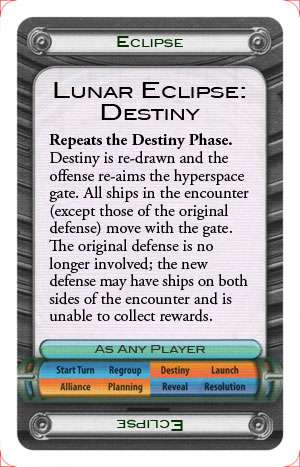 The cards would allow a player to affect a certain phase of the encounter in some way that hopefully gives him or her an advantage. There are a lot of interesting possibilities, and it's a good fit for the Reward deck.
Below are some examples of the cards:
Solar Eclipse (Regroup): Skips the Regroup Phase. The offense does not retrieve a ship from the warp. This effect may not be played if the offense has no available ships.
Solar Eclipse (Destiny): Skips the Destiny Phase. The hyperspace gate remains in the previously-attacked system; the defense is the same player as the previous encounter. This effect may not be played if the offense was defending in the previous encounter or there has been no previous encounter.
Solar Eclipse (Launch): Skips the Launch Phase. The defense points the hyperspace cone. The offense launches a single ship.
Lunar Eclipse (Launch): Repeats the Launch Phase. The offense may re-aim the hyperspace gate and launch an additional 1-4 ships.
Lunar Eclipse (Alliance): Repeats the Alliance Phase. All allied ships are returned to colonies before allies are re-invited.
Lunar Eclipse (Planning/Reveal): Repeats the Planning and Reveal Phases. Encounter cards are selected in addition to the ones already played; a new encounter card only interact with the opponent's new encounter card and vice versa. A negotiate card is ignored if a player's other encounter card is an attack.
Thursday, July 8, 2010
Inverted Praw
A nice alternative to the Praw (or the kinder, gentler version) from Patrick Riley:
When ships are lost, they go to the Praw. All references to "Warp" in power descriptions should be read as "Praw" except Warpish, who counts the ships in both the Warp and the Praw.This delays getting ships back into the game (making them a much more valuable resource), but the potential delay is not necessarily as long as it is when using the normal Praw rules (see The Warp for more Warp variants).
From the Praw, ships must first move to the Warp before returning to colonies. Ships never move from the Warp to the Praw; i.e., there is no "flushing" effect.
At the beginning of your encounters, you may either move a ship from the Warp to a colony (or the gate), or move a ship from the Praw to the Warp.
When a Mobius Tubes is played, all the ships in the Warp return to colonies and all the ships in the Praw go to the Warp. Warp Break works the same way except only one color of ships is affected.
Monday, June 28, 2010
Most Wanted Alien
The next expansion for Cosmic Encounter is most likely in the preparation stages, and aliens are being selected for inclusion. Which alien would you most like to see included?
Below is a poll that includes most of the classic Eon aliens (a few notable exceptions, like Insect, which is arguably close enough to Plant that it will probably not be included yet, and Worm, which is a little bit on the lame side). No Mayfair aliens are on this list, but I wouldn't count them out for consideration anyway.
Below is a poll that includes most of the classic Eon aliens (a few notable exceptions, like Insect, which is arguably close enough to Plant that it will probably not be included yet, and Worm, which is a little bit on the lame side). No Mayfair aliens are on this list, but I wouldn't count them out for consideration anyway.
Monday, June 21, 2010
Tweaked Aliens
The Fantasy Flight version of Cosmic (including the Cosmic Incursion expansion) has had a number of aliens from previous editions of CE, but modified for one reason or another. There have been a number of revisions to the original powers over the years. The Warp currently has 26 revisions (not counting changes made in the FFG edition).
And there was a newsgroup posting about it in 2004 by Rob Burns: rec.boardgames.ce which Peter Olotka responded to with these thoughts:
1) Chosen. I actually advocated pretty strongly for changes to Chosen, which to me always seemed like a great idea for a power, but never in any game I ever played did I see it do any good. I had a couple of different revisions to Chosen on The Warp, and the FFG version went to an even more souped up version. Originally, Chosen could only replace his revealed encounter card with the next encounter card from the deck. The odds of it being a better card were not generally high. I think the changes FFG made did improv Chosen, though I would have preferred to not have the new cards adding to the original one. I would have been fine with allowing Chosen to replace an encounter card with any one new encounter card, or any combination of attack cards. Including the original version from Mayfair in the new set would have been a waste of an alien card.
1) Dictator. A pretty strong case can be made that the new version of Dictator is weaker than the old one, and I don't argue that. Originally, Dictator would simply decree the color of each Destiny flip, even to the point of forcing everyone else to always attack the same person. In fact, I remember a game where the Dictator player forced everyone else to attack me, every single encounter. He felt that since I won most of the time, I was the biggest threat (no matter what alien I or anyone else had), and his goal was to force me to lose all of my home colonies- and even after I did lose them all, he kept having everyone else attack me. He didn't even come close to winning, so ultimately I didn't see the point. Needless to say, it wasn't my most enjoyable game, and in fact pretty much no one enjoyed that game.
That's a pretty extreme example, but it does illustrate the "abuse of power" that the original Dictator was capable of. I like to think the new version, which is identical to a revision that Patrick Riley proposed many years ago, is more strategic to play (and play against). This was a change that was less about strength of the alien, and more about overall potential gameplay enjoyment. I find that many of the changes FFG has made try to touch on this element as much as any notion of "game balance" (a notion that is difficult to maintain in a game like CE).
3) Grudge. This alien only got to use his power when he won his encounter without the help of players he invited. Mayfair added in that even when Grudge loses, the invited players must still lose a ship (two ships actually). FFG flipped this around. Grudge now punishes those non-allies more when he loses. If Grudge has asked three player to ally, and they've instead allied with Grudge's opponent, he is much more likely to lose that encounter, and I think those players definitely should pay more for snubbing Grudge. Whether or not you think the Grudge tokens are useful to have, this change to Grudge is a welcome one. There wasn't really anything particularly "wrong" with the first version, but I think you now have to weigh the alliance invitation even more.
4) Macron. This alien has the dubious honor of being the most frequently revised alien (though only revised once in a printed edition). The big concerns with Macron are his vulnerability to effects that can pick off a lone ship on a colony (powers like Shadow and Hate for instance), and the issue of compensation and rewards. With only 1 ship in the encounter, Macron was only ever able to pick up 1 card or ship when collecting compensation or rewards. The FFG change gives Macron double the compensation or rewards per ship (typically a total of 2). It's a decent compromise, though it doesn't do much to protect Macron's vulnerable colonies.
5) Symbiote. The new version is stronger and more flexible, since all 40 ships count for the win in every circumstance. The other tweak that was making Symbiote unzappable. This was part of also making it so you could never steal, copy, or do anything else to Symbiote, in an effort to head off any of the multitude of power interaction questions (like how does Plant affect it?). I had a lot more fun seeing the original version in play. It was interesting to watch the Symbiote player manage the two colors (since only the primary colored ships counted for foreign colonies). I think that element could have been retained, and the "you can not steal or copy" etc. aspects could have been included.
6) Virus. The Eon and Mayfair versions of Virus let him multiply all ships on his side (his and allies). The FFG version only multiplies the Virus ships, and allies are added normally. This is also the version of Virus that is used online. I'd be curious to know if it was a change made to the power to temper it, or a change made out of necessity coding-wise. I think this change, while weakening Virus, isn't a bad thing. Virus is frequently regarded as one of the biggest powerhouse aliens out there. It's a red-alert alien in FFG, because new players take a look at it and ask "how can you ever beat this alien?". It can be done, and this version is at his strongest early in the game. Later, when resources are usually spread thin, Virus loses some of his edge, especially on defense. But even multiplying your attack card by two, rather than merely adding 2, is still a significant advantage.
7) Void. Old Void could eradicate you right out of the game. I've only seen it happen once, but the fear of it happening was always present. New Void puts on the brakes when you get down to just enough ships to still be able to win. As above, this was a decision made from overall gameplay enjoyment... but I think I would have left it well enough alone.
Minor Tweaks
8) Clone. The only real change was clarifying that Clone's encounter card doesn't return to hand until after compensation, which means if he's got a great card, he'll get to keep using it until zapped (you can't steal it from him by negotiating). A very nice bit of clarification there.
9) Deuce. The big change here was making the second encounter card played by Deuce not count as an encounter card, and thus unaffected by any other alien that does something to your encounter card (e.g., Sorcerer). This is a great way to deal with all of those potential debates. Bravo.
10) Ethic. Previously a lucre power, Ethic didn't really need to be, and now it simply isn't. Patrick Riley proposed this change a few years back, and it's pretty sensible. Of course, there aren't that many good lucre powers, and now there's one fewer. However, I don't expect to see lucre powers any time soon from FFG, if ever. Mayfair's Ethic could discard some or all cards taken as compensation, but the other change FFG's version has is the ability to take the compensation from the deck instead of the other main player. The aliens that get something for losing aren't as fun for me as those that help you win, but it's nice to get something for your trouble, and the changes here are fine.
Other interesting revisions
11) Crystal. One of my least favorite aliens (although still preferred over Worm) has always been Crystal. In an effort to make it more interesting and perhaps more enjoyable for everyone in the game, I revised it thusly:
12) Demon. An alien that many people groaned about seeing in the game. I wanted to find a way to make Demon more of a strategic alien to have in the game and less of a crapshoot.
13) Diplomat. Some great suggestions and discussions have take place on BoardGameGeek about revising this alien. Check them out here. I do enjoy the new direction it has taken.
14) Doppelganger. This alien was radically changed from the Eon version to the Mayfair version, and no word yet if it will ever surface in the FFG version. Eon's was pretty formidable (take the highest attack card and "negotiate" card from your opponent every time you're a main player. This was another alien that confounded many people regarding how you can ever beat it, and certainly led to the changes. Mayfair tried to keep the spirit of the alien, and added some interesting psychological twists. You gave Doppelganger any two cards from your hand, and he could either keep them, or set them aside and look through your hand for two he wanted. So it became a game of psyching out Doppelganger by either giving him one good card and a crappy one to see if he'd keep it, or giving him your best card and something else while hoping he'd think there's even better stuff you're still holding onto. I tried to find some middle ground with this revision:
15) Empath. A lot of people unfairly characterize Empath as a weaker version of Pacifist. While they both use negotiates to their advantage, Empath has more flexibility on defense. However, I found making Empath mandatory to be too limiting. I made this revision:
Final thoughts
There are quite a few other revisions on The Warp (some lucre changes, like Rob Burn's change to Force), including alternate versions of aliens in the FFG edition of CE. Some are definitely worth trying out. As Peter said, it's fun to see what new outcomes may take place. It's a fun way to think about creating aliens for CE- many homebrews are really just variations on an existing alien.
And there was a newsgroup posting about it in 2004 by Rob Burns: rec.boardgames.ce which Peter Olotka responded to with these thoughts:
I think that tweaking is more of an exercise in design for the fun of seeing what might happen with differing variants, than in "making cosmic better' because the aliens are fundamentally flawed.Here is a look at 10 changes aliens, and my thoughts on the pros and cons of the changes.
1) Chosen. I actually advocated pretty strongly for changes to Chosen, which to me always seemed like a great idea for a power, but never in any game I ever played did I see it do any good. I had a couple of different revisions to Chosen on The Warp, and the FFG version went to an even more souped up version. Originally, Chosen could only replace his revealed encounter card with the next encounter card from the deck. The odds of it being a better card were not generally high. I think the changes FFG made did improv Chosen, though I would have preferred to not have the new cards adding to the original one. I would have been fine with allowing Chosen to replace an encounter card with any one new encounter card, or any combination of attack cards. Including the original version from Mayfair in the new set would have been a waste of an alien card.
1) Dictator. A pretty strong case can be made that the new version of Dictator is weaker than the old one, and I don't argue that. Originally, Dictator would simply decree the color of each Destiny flip, even to the point of forcing everyone else to always attack the same person. In fact, I remember a game where the Dictator player forced everyone else to attack me, every single encounter. He felt that since I won most of the time, I was the biggest threat (no matter what alien I or anyone else had), and his goal was to force me to lose all of my home colonies- and even after I did lose them all, he kept having everyone else attack me. He didn't even come close to winning, so ultimately I didn't see the point. Needless to say, it wasn't my most enjoyable game, and in fact pretty much no one enjoyed that game.
That's a pretty extreme example, but it does illustrate the "abuse of power" that the original Dictator was capable of. I like to think the new version, which is identical to a revision that Patrick Riley proposed many years ago, is more strategic to play (and play against). This was a change that was less about strength of the alien, and more about overall potential gameplay enjoyment. I find that many of the changes FFG has made try to touch on this element as much as any notion of "game balance" (a notion that is difficult to maintain in a game like CE).
3) Grudge. This alien only got to use his power when he won his encounter without the help of players he invited. Mayfair added in that even when Grudge loses, the invited players must still lose a ship (two ships actually). FFG flipped this around. Grudge now punishes those non-allies more when he loses. If Grudge has asked three player to ally, and they've instead allied with Grudge's opponent, he is much more likely to lose that encounter, and I think those players definitely should pay more for snubbing Grudge. Whether or not you think the Grudge tokens are useful to have, this change to Grudge is a welcome one. There wasn't really anything particularly "wrong" with the first version, but I think you now have to weigh the alliance invitation even more.
4) Macron. This alien has the dubious honor of being the most frequently revised alien (though only revised once in a printed edition). The big concerns with Macron are his vulnerability to effects that can pick off a lone ship on a colony (powers like Shadow and Hate for instance), and the issue of compensation and rewards. With only 1 ship in the encounter, Macron was only ever able to pick up 1 card or ship when collecting compensation or rewards. The FFG change gives Macron double the compensation or rewards per ship (typically a total of 2). It's a decent compromise, though it doesn't do much to protect Macron's vulnerable colonies.
5) Symbiote. The new version is stronger and more flexible, since all 40 ships count for the win in every circumstance. The other tweak that was making Symbiote unzappable. This was part of also making it so you could never steal, copy, or do anything else to Symbiote, in an effort to head off any of the multitude of power interaction questions (like how does Plant affect it?). I had a lot more fun seeing the original version in play. It was interesting to watch the Symbiote player manage the two colors (since only the primary colored ships counted for foreign colonies). I think that element could have been retained, and the "you can not steal or copy" etc. aspects could have been included.
6) Virus. The Eon and Mayfair versions of Virus let him multiply all ships on his side (his and allies). The FFG version only multiplies the Virus ships, and allies are added normally. This is also the version of Virus that is used online. I'd be curious to know if it was a change made to the power to temper it, or a change made out of necessity coding-wise. I think this change, while weakening Virus, isn't a bad thing. Virus is frequently regarded as one of the biggest powerhouse aliens out there. It's a red-alert alien in FFG, because new players take a look at it and ask "how can you ever beat this alien?". It can be done, and this version is at his strongest early in the game. Later, when resources are usually spread thin, Virus loses some of his edge, especially on defense. But even multiplying your attack card by two, rather than merely adding 2, is still a significant advantage.
7) Void. Old Void could eradicate you right out of the game. I've only seen it happen once, but the fear of it happening was always present. New Void puts on the brakes when you get down to just enough ships to still be able to win. As above, this was a decision made from overall gameplay enjoyment... but I think I would have left it well enough alone.
Minor Tweaks
8) Clone. The only real change was clarifying that Clone's encounter card doesn't return to hand until after compensation, which means if he's got a great card, he'll get to keep using it until zapped (you can't steal it from him by negotiating). A very nice bit of clarification there.
9) Deuce. The big change here was making the second encounter card played by Deuce not count as an encounter card, and thus unaffected by any other alien that does something to your encounter card (e.g., Sorcerer). This is a great way to deal with all of those potential debates. Bravo.
10) Ethic. Previously a lucre power, Ethic didn't really need to be, and now it simply isn't. Patrick Riley proposed this change a few years back, and it's pretty sensible. Of course, there aren't that many good lucre powers, and now there's one fewer. However, I don't expect to see lucre powers any time soon from FFG, if ever. Mayfair's Ethic could discard some or all cards taken as compensation, but the other change FFG's version has is the ability to take the compensation from the deck instead of the other main player. The aliens that get something for losing aren't as fun for me as those that help you win, but it's nice to get something for your trouble, and the changes here are fine.
Other interesting revisions
11) Crystal. One of my least favorite aliens (although still preferred over Worm) has always been Crystal. In an effort to make it more interesting and perhaps more enjoyable for everyone in the game, I revised it thusly:
You have the power of Arrangement. Whenever you are a main player or ally in an encounter, use this power to give a Crystal token to each ally (including yourself, if you are an ally). Players must send the number of ships indicated by the token they are given, and may not refuse to ally if they have already accepted. A player who receives a 0 token is still considered an ally involved in the encounter, but has zero ships committed.Like the Dictator revision, I like how it forces Crystal to work with what he's got. The original Crystal gave the allies an easy out by deciding not to ally after being told how many ships to commit. I like taking that option away. Crystal can only "screw" one player by forcing a commitment of 4 (or of 1) when the player clearly wanted a different number. The love, so to speak, is spread around a little more this way.
12) Demon. An alien that many people groaned about seeing in the game. I wanted to find a way to make Demon more of a strategic alien to have in the game and less of a crapshoot.
You have the power to Possess. Any time you are not involved in an encounter, use this power to attack the offensive player after both sides have played encounter cards but before they are revealed. You place 1-4 of your ships outside of the Hyperspace Gate and play an encounter card facedown. You and the offensive player reveal cards and resolve your mini-encounter (without allies). If the offensive player wins, your ships go to the Warp. If you win, his ships return to colonies, and your ships take over his encounter. You may now resolve the original encounter with either card played in the pre-encounter.The downside is the additional time this adds to the game, though in reality I think it's pretty negligible. Instead of the offensive player deciding to either play a good encounter card and hope Demon doesn't possess, or playing a crappy card and hoping Demon does possess- now there's an element of having to be able to beat the Demon AND your regular opponent. And Demon now has the option of using the card played by the original offensive player. Imagine a player attacking Anti-Matter and playing a low attack card, but Demon swoops in with a high card and beats that player (only to turn around and use that player's original low attack card against Anti-Matter). It's still an invasive power (a reason that the "enhanced gameplay" mindset of the FFG version will likely avoid this alien), but I think a better way to approach it.
13) Diplomat. Some great suggestions and discussions have take place on BoardGameGeek about revising this alien. Check them out here. I do enjoy the new direction it has taken.
14) Doppelganger. This alien was radically changed from the Eon version to the Mayfair version, and no word yet if it will ever surface in the FFG version. Eon's was pretty formidable (take the highest attack card and "negotiate" card from your opponent every time you're a main player. This was another alien that confounded many people regarding how you can ever beat it, and certainly led to the changes. Mayfair tried to keep the spirit of the alien, and added some interesting psychological twists. You gave Doppelganger any two cards from your hand, and he could either keep them, or set them aside and look through your hand for two he wanted. So it became a game of psyching out Doppelganger by either giving him one good card and a crappy one to see if he'd keep it, or giving him your best card and something else while hoping he'd think there's even better stuff you're still holding onto. I tried to find some middle ground with this revision:
You have the power to haunt. At the start of the game, you do not receive an eight-card hand. Instead, each time you are a Main Player in an encounter, use this power demand two encounter cards from any player involved in the encounter (your opponent or any allies). That player decides which two to give you. After seeing the cards, you may either accept them, or you may set them aside and search through his remaining encounter cards and take two you like. You must take two cards from that player unless he started with only three, meaning he had only one left to take after you set two aside; in this case you get the one card remaining. After you have taken cards, the player gets the rest of his hand back, including cards that you set aside. The encounter then proceeds normally. At the end of the encounter, any cards you borrowed but did not use return to their previous owner. As long as you have use of your power, you never draw a new hand for lack of encounter cards. Any non-challenge cards you accumulate throughout the game may be held until played.It works very much like the Mayfair version, but is restricted to encounter cards. It's been fun to play, and I think still captures the intent of both previous versions.
15) Empath. A lot of people unfairly characterize Empath as a weaker version of Pacifist. While they both use negotiates to their advantage, Empath has more flexibility on defense. However, I found making Empath mandatory to be too limiting. I made this revision:
You have the power of Harmony. As a main player in an encounter, if only one player reveals a negotiate card, you may use this power to change both revealed cards to negotiates.I think this lets Empath decide when it's most convenient to be in a deal situation. Sometimes Empath wants to get compensation (if his opponent has the Empath flare, or whenever Genius is in the game). And sometimes Empath wants his opponent to take compensation. Finally, if Empath is the defense and his opponent plays a negotiate, it's nice for Empath to still have the opportunity to gain something from a deal situation, rather than just winning (and gaining nothing). It's a pretty subtle change, but with big result possibilities.
Final thoughts
There are quite a few other revisions on The Warp (some lucre changes, like Rob Burn's change to Force), including alternate versions of aliens in the FFG edition of CE. Some are definitely worth trying out. As Peter said, it's fun to see what new outcomes may take place. It's a fun way to think about creating aliens for CE- many homebrews are really just variations on an existing alien.
Tuesday, June 1, 2010
Alliance Cards variant
 Stefan Lopuszanski's idea for cards that allies play face down do their commitment to the alliance can be kept secret until everyone has responded has been extremely entertaining to play with.
I created a set of cards that don't require specific colors. Every player invited to ally must play a card (even if they do not intend to ally, they must play a card with zero ships). I've also included a zero card for offense as well as defense, in case players want to indicate the side they are ally with, while keeping the amount of ships secret.
Cards have "Ally with", either "Offense" or "Defense" and from 0-4 ships.
Some additional variants:
* We sometimes do not reveal the alliance cards until the encounter cards are revealed. This creates some tension for the main players, since they do not know how many ships are on each side.
I added a Special Destiny card to my set that requires players to keep their Alliance cards secret until the reveal stage.
* The latest variant involves dealing out 1 Alliance card at random to each player at the start of the game. Each encounter, the Offensive player draws an additional Alliance card for each potential ally. During the alliance phase, the Offensive player must hand an Alliance card to each potential ally before inviting allies.
Players may only ally if invited, and they may only commit per the card they play. Each player has limited options early in the game. To make matters even more interesting, invitations are open ended. That is, the offensive and defensive players can invite any player they like, but the invitation is open to either side. So if Red is the offensive player, and invites Yellow to ally. Yellow can ally with either side (per whatever his or her Alliance card allows).
This gives the offensive player a slight advantage, since he or she knows what cards have been added to the mix, but there's always at least one card that is unknown.
Sometimes this variant calls for turning in and redealing all Alliance cards after each turn, to really shake things up.
Sunday, May 23, 2010
Cosmic Incursion Reviews

It's taken some time before some user reviews of CI finally surfaced.
Gerald Katz posted one on the rec.boardgames.ce newsgroup- mostly positive:
"Hooray for the return of Kickers, Negative Attack Cards, and some
Edicts (Artifacts) like Space Junk and Hand Zap.
I like the crooked Negotiates. +1 compensation or -1/+1 ship to the
warp on failed deal..."
Nate Owens posted an even glowier review on boardgamegeek:
"It’s a welcome expansion, and the extra variety is so good, I would recommend this expansion be bought when you pick up the base game."
Of course, I'm pretty biased when it comes to Cosmic Incursion, but I think it's a fantastic addition to CE, and I highly recommend it. The 6th player color let's you have a bigger and more intense game- or you can just use the ships to play with Symbiote in a 5 player game.
The 20 aliens are a great mix of old a new. Sniveler was one of the most requested classic alien, and it's joined by several others I've always been fond of (Chronos, Seeker, and Plant).
Finally, I've been a long advocate of the Reward Deck (naturally). I like the fact that it makes defensive alliances an even more serious consideration for all players. While not everything in the Reward Deck is great, the lure is often too hard to resist. The first game I played with CI, I drew four rewards (all of the negative cards and a negotiate). It was a serious bust. But since I was playing Ghoul, I was tapping into the Reward Deck a lot, so the next time I ended up drawing a pair of artifacts, a kicker, and a high attack card. It's worth the gamble.
If you love Cosmic Encounter, then this expansion is a must. Even if you only like CE, I think the expansion adds quite a bit and will enrich your experience. We're less than a year away from the next expansion, which I'm eagerly awaiting... if it's in the same league as CI, it will be another great addition.
Sunday, May 9, 2010
Alien Strategy Series: Clone

First appearance: Eon base set.
Plain-English power: May keep own encounter card.
Loved by: Mutant; Hacker; Magician, Barbarian.
Loathed by: Filch.
Three ways to win as Clone:
- Spend some time early in the game trying to get cards as rewards. Once you can get your hands on a great encounter card, like the 30 or 40, you'll be extremely hard to stop.
- It's difficult to get a new hand of cards as Clone, so if you think you'd like a new hand, you'll have to not use your power early and often. It may be better to go ahead and keep those undesirable cards, so you can retain them for compensation to other players. No sense making it easier for them to get any of your decent cards, like artifacts or flares.
- Commit your ships to the encounter when you are the attacker. Everyone assumes Clone has a great card, even before they've seen anything he's played. You can bluff players sometimes, and until you know how good your best card is, having four ships in there may be the difference between a win and a loss.
- If Clone has a particularly good card, you need to get it out of his hand, or he'll mop the floor with you. This is an alien that's worth spending a Cosmic Zap on- otherwise that encounter card will be the gift that keeps giving. With other aliens, like Virus or Anti-Matter or even Loser, a Cosmic Zap becomes more about waiting for the right moment to play. Stopping Clone with a 40 is in everyone's best interests.
- Gang up on Clone, especially when you know what his best card probably is (the one he keeps playing). You can do the math, because you know what spread you have to beat.
- Clone will probably play his best card on defense as well as offense, because why not? Ally with him if you don't think the offense can beat the spread, and get some good cards out of the deal. Similarly, don't invite Clone to ally with the defense, because you can't afford letting him get an even better encounter card.
The FFG version of Clone clearly indicates that his or her encounter card is not really subject to compensation. The power text explains, "...after the encounter is resolved (and after any compensation is claimed), you may use this power to return your encounter card to your hand instead of discarding it." Thus, the encounter card is still lying face up on the table and not part of the hand. In past versions of CE, this was certainly an area that was open to debate, and I know my group discussed whether or not Filch could take Clone's card, or if anyone could get that card by negotiating for compensation. This version definitely makes Clone more powerful.
At CE Online? Yes.
Monday, May 3, 2010
Constellations
 This is an expansion that directs the objectives for each player at the start of the game.
History:
When certain stars and planets are lined up, they form shapes in the sky. In the game, players try to capture specific planets in different systems.
Additional Equipment:
A set of Constellation cards, kept separate from the regular deck.
Additional Set-up:
Each player draws a Constellation card at the start of the game. Cards may be played face-up, or secretly.
Play:
Each player has a Constellation card that outlines which planets in various planetary systems they must occupy in order to win the game. In six player game, for example, the card will show which foreign colonies you must occupy, and which home colony you must retain. In games with only four or five players, the card will show the home colony and a number of foreign colonies needed (and the remaining number of foreign colonies can be on any foreign planets.
This has a subtle (and sometimes not-so-subtle) effect on game play. Obviously, when one player is attacking a colony they need, other players may not be so anxious to ally on the offensive side if it is not a colony they also need. Uninvolved players will ally with the Defensive Main Player more often than in regular games (if there is such thing as a "regular" game).
Players will also have to defend certain home colonies more fervently, or actually make attacks against their home system in order to regain a colony (something that rarely occurs in games with our group).
The cards themselves will have many duplicate bases (depending on the number of players), so that joint attacks are still potentially beneficial for more than one party. The set of cards can continue to grow, depending on whether or not players wish to include moons in their win objectives, as well as other expansions.
In order to account for many different scenarios, I have constructed different Constellation "decks" for different numbers of players in a game. The actual formations of the Constellation are, of course irrelevant, but feel free to connect the planets and decide what shape they make.
Custom Constellations cards on Artscow.
Wednesday, April 21, 2010
Alien Strategy Series: Barbarian

First appearance: Fantasy Flight CE
Plain-English power: Ransacks opponent's hand, keeping what he wants, trashing the rest.
Loved by: Masochist. Love is probably too strong to describe Masochist's feelings about Barbarian, but it's all relative. Most aliens don't have much love for this guy.
Loathed by: Genius, Remora, and anyone that finally drew their own flare card.
Three ways to win as Barbarian:
- Commit big as the offense. You only get to use your power on your turn when attacking, so you should increase the odds as much as you can. Putting four ships in the gate will send a signal to the other players that you are confident you'll win, and it will attract more allies to your side and fewer to the defense's. Plus, the more ships you commit, the more cards you keep from the loser.
- Play the good cards early. Sometimes players are tempted to save their good attack cards for later in the game. When it's your turn, go for it. If you win, you'll get access to your opponent's hand, and if he or she has been saving some good cards, you'll get them.
- Ally with the defense when it's not your turn. You want to slow down other players from getting colonies, but you also want to keep adding good cards to your hand whenever you can. Then, when it's your turn, you have better cards to help you win, and other players have more incentive to ally with you.
Three ways to win against Barbarian:
- Unless you feel very confident that you can win as the defense against Barbarian, you might want to think about playing your negotiate. Barbarian loots your hand, but you get to collect your compensation after- so you may get back some of the good cards you had. Also be sure to consider playing all of your reinforcements onto Barbarian's side. No point in giving him any of those cards.
- Play your best attack card. If you don't, you may end up losing it anyway. Remember, you don't just lose the colony, you lose your hand. And even if you want to lose your hand, you don't want Barbarian to get the good card you didn't play.
- Barbarian is a great target for a plague. Even if he hasn't looted any player yet, a plague will weaken him and make it less likely he'll win on his turn.
Barbarian relies on getting some good cards on his turn. If you ally against him, you can shut him down for several encounter until his turn comes back around. Allying with the defense can also give you access to good cards in you're using the Reward deck. In those games, Barbarian will be even more keen on winning as the offense, so you must convince the other players to gang up on him.
At CE Online? No.
Tuesday, April 20, 2010
Power Selection Variants
A fun and easy twist on the game is to change up how you select the aliens for the game. The normal method is to deal out two and pick the one you like more. But there's plenty of other interesting methods for selecting your power. An idea called "Bid Drafting" was recently proposed and discussed on BoardGameGeek, which I recently tried out. It was a fun way to start the game and actually reminded me a little of Spice Harvest for Dune.
Some of the others I have enjoyed over the years include:
BOGGLE: This is a fun variation (especially in a set with over a lot of powers). Each player writes down the names of 5 powers that they would like to have, along with 5 powers that they don't want anyone to have. Read off the list. Any powers that are on more than one list are eliminated, and the powers that you wanted that are not on another list are yours. Each player may therefore have anywhere from 1 to 5 powers (If all of your choices are eliminated, you may pick one power at random). This allows for some creative thinking and allows powers that are otherwise fairly weak to be used to their utmost advantage.
DRAW STRAWS: Draw a number of powers equal to the number of players. Randomly choose a player to pick first. That player then takes all the powers and picks one for himself. He passes the powers to the next player clockwise, who repeats the process. The last player will get the least desired power. Then draw another set of powers and give them to the last player. He picks in the same manner as first player did, then passes counter clockwise. Powers should remain hidden until everyone has chosen both sets. This can be used for deciding between two powers, but more often it's used for double-power games.
PICK AND PASS: Each player draws three powers at random. One power they choose for themselves, the second one is thrown away, and the last one is passed to the player on their right. You may not look at the passed power until you have chosen your powers to pick and pass, etc. You must play the power passed to you.
TIDY BOWL: Deal 5 powers to each player. Put two powers "in" and the rest "out". All the "in" powers are shuffled together and dealt randomly.
More selection methods can be found on The Warp.
Some of the others I have enjoyed over the years include:
BOGGLE: This is a fun variation (especially in a set with over a lot of powers). Each player writes down the names of 5 powers that they would like to have, along with 5 powers that they don't want anyone to have. Read off the list. Any powers that are on more than one list are eliminated, and the powers that you wanted that are not on another list are yours. Each player may therefore have anywhere from 1 to 5 powers (If all of your choices are eliminated, you may pick one power at random). This allows for some creative thinking and allows powers that are otherwise fairly weak to be used to their utmost advantage.
DRAW STRAWS: Draw a number of powers equal to the number of players. Randomly choose a player to pick first. That player then takes all the powers and picks one for himself. He passes the powers to the next player clockwise, who repeats the process. The last player will get the least desired power. Then draw another set of powers and give them to the last player. He picks in the same manner as first player did, then passes counter clockwise. Powers should remain hidden until everyone has chosen both sets. This can be used for deciding between two powers, but more often it's used for double-power games.
PICK AND PASS: Each player draws three powers at random. One power they choose for themselves, the second one is thrown away, and the last one is passed to the player on their right. You may not look at the passed power until you have chosen your powers to pick and pass, etc. You must play the power passed to you.
TIDY BOWL: Deal 5 powers to each player. Put two powers "in" and the rest "out". All the "in" powers are shuffled together and dealt randomly.
More selection methods can be found on The Warp.
Friday, April 16, 2010
Cosmic Express
About a year ago, a clever and amusing version of Dune came out called Dune Express (it uses a lot of dice and some simple components, and was the Golden Geek winner 2009 for Print & Play).
Now there's an "express" version of CE called Cosmic Express (also called Cosmic Dice) from Nathan Bryan.
The first version of Dune Express was decent, but what really made it come alive was a lot of upgraded fan-made components). Cosmic Express is also light on the production design, but if it does get jazzed up, it looks like a nice diversion. It takes at least 3 players, and if it's anything like real CE, 4 or 5 would be better (though if that's the case, you should all just break out the real CE and play that).
 One of the best aspects of Cosmic Encounter is the variable player powers, and Cosmic Express does have that. Nathan has created power cards for over 50 aliens (those in the FFG's set, and a few new ones, like Conqueror and Psychic).
I never gave Dune Express a try, but I may have to take a look at the Cosmic version.
Now there's an "express" version of CE called Cosmic Express (also called Cosmic Dice) from Nathan Bryan.
The first version of Dune Express was decent, but what really made it come alive was a lot of upgraded fan-made components). Cosmic Express is also light on the production design, but if it does get jazzed up, it looks like a nice diversion. It takes at least 3 players, and if it's anything like real CE, 4 or 5 would be better (though if that's the case, you should all just break out the real CE and play that).
 One of the best aspects of Cosmic Encounter is the variable player powers, and Cosmic Express does have that. Nathan has created power cards for over 50 aliens (those in the FFG's set, and a few new ones, like Conqueror and Psychic).
 I never gave Dune Express a try, but I may have to take a look at the Cosmic version.
Wednesday, April 14, 2010
Power of the Day Returns
Gerald Katz is back to posting an alien power each day, now on BoardGameGeek. These posts originally appeared on rec.games.board.ce over the course of many years.
The one thing I have particularly enjoyed is watching the evolution of some of the homebrew aliens. Comments from other players sometimes inform the development, and also changes to the game itself have contributed to how the aliens have been created.
The one thing I have particularly enjoyed is watching the evolution of some of the homebrew aliens. Comments from other players sometimes inform the development, and also changes to the game itself have contributed to how the aliens have been created.
Sunday, April 11, 2010
Nova Cards
I recently issued a plea on the CE newsgroup for information about Mayfair's never-released expansion for Cosmic Encounter that tantalized players for a long time, was play tested, and on the verge of release when.... it wasn't. Nova cards.
Responding the most popular complaint about its edition of CE, the one-shot flares, Mayfair cooked up a new card that would behave like the classic Eon flare (play it, but don't discard it). There would be one Nova card for each alien in the game. That was about all the information that was ever released.
Now, it's more than a decade later, and I've always wanted to know what the content of the Nova deck was going to be. I felt there was no reason to keep the data secret anymore... people worked hard on creating it- it deserved to be shared and discussed. I didn't really get the information I wanted, but close. Gerald Katz explained that the Nova cards were essentially going to be a new version of his Pulsar cards (also known as Immunity cards). Gerald has been posting Pulsars for every CE alien (including many homebrews) for years- which to me says that it's even more all right for someone who had access to the "official" rules for Novas to just send that stuff to me, but I digress).
Nova cards, like Flares, have two headings: Con and Pro. The Con heading is an immunity to the effects of the power listed on the card. It partially or completely nullifies that power, ala Cosmic Zap to some degree, but often only to the benefit of the card holder. The Pro heading was only used if you held your own power's Nova, giving your power a boost like a Super Flare (but a different effect than the Flare).
For example, if you held the Anti-Matter Nova, all allies' ships add to the encounter total (his allies as well as yours). Conversely, if Anti-Matter held his own Nova, the effect is his opponent's allies add to the encounter total instead of subtracting.
In an article on the newsgroup, Gerald explained that he almost ditched the idea since they were too close to flares, but when Mayfair's one-shots came out, he decided they were a great way to reintroduce a retained card to the game.
That brings us to the FFG edition, which does have the classic Eon style of retained flares. Would it be too weird to have a second flare-like card in the game? One of the unfortunate things about flares is that you rarely ever get your hands on your own Super. I didn't want to see a game where you had two cards for your alien power and even less chance of seeing one of them. I was on the fence about it, but then I thought about the Reward deck. What if you added a Nova card for each power in the game and shuffled them into the Reward deck? No extra Novas were added- only powers in the game, meaning each one that did come up would be relevant. The Reward deck is smaller than the encounter deck, so you had a better chance of getting a Nova for a power being used into the game. It might still be hard to get your own Nova, but now you have the added tension of having a player acquire your Nova and becoming somewhat immune to your power.
It's no secret that I am a big fan of the Reward deck. I like that makes people think twice as the defense about inviting players to ally (and think carefully about whom to invite). It makes other players think hard about which main player to ally with. And it makes the offense have to worry about whether or not he invites certain players on offense, because if he doesn't invite them, the defense just might. Plus, before the Reward deck, if you did ally with the defense, and drew cards from the deck as your reward, you stood an excellent chance of drawing cards you didn't want. The odds of getting something good are a little better in the Reward deck (no guarantee, which is how it should be).
If you mixed in 3-6 more cards, it doesn't have a huge effect on the Reward deck distribution, but it does make you a little bit more keen on accessing it. And, the Rift cards take on an even bigger role in the game when you know someone has a Nova in his or her hand, and you want to target it for compensation. If the dozen or so games I've played with Cosmic Incursion, I haven't felt much of a need to hold onto my Rift cards as a deterrent. I just play them and get the ships out of the warp. If I had a Nova in my hand, I would be more inclined to keep a Rift if I could afford to.
Culling info from old newsgroup posts by Gerald, and noodling up my own info on the new aliens, I have created my own set of Nova cards and add them to my Reward deck when playing. The first game was about a week ago, and it was very well received. We got three of the six Novas into play. Only one of the flares for the powers in the game was played, and as a Wild, not a Super. There was also a desperate move by one player to take his Nova out of another player's hand through compensation, and it took him two tries to do it. The cost in ships was pretty high (7), but it ultimately led to his sharing a win with only one other player in a six player game.
Responding the most popular complaint about its edition of CE, the one-shot flares, Mayfair cooked up a new card that would behave like the classic Eon flare (play it, but don't discard it). There would be one Nova card for each alien in the game. That was about all the information that was ever released.
Now, it's more than a decade later, and I've always wanted to know what the content of the Nova deck was going to be. I felt there was no reason to keep the data secret anymore... people worked hard on creating it- it deserved to be shared and discussed. I didn't really get the information I wanted, but close. Gerald Katz explained that the Nova cards were essentially going to be a new version of his Pulsar cards (also known as Immunity cards). Gerald has been posting Pulsars for every CE alien (including many homebrews) for years- which to me says that it's even more all right for someone who had access to the "official" rules for Novas to just send that stuff to me, but I digress).
Nova cards, like Flares, have two headings: Con and Pro. The Con heading is an immunity to the effects of the power listed on the card. It partially or completely nullifies that power, ala Cosmic Zap to some degree, but often only to the benefit of the card holder. The Pro heading was only used if you held your own power's Nova, giving your power a boost like a Super Flare (but a different effect than the Flare).
For example, if you held the Anti-Matter Nova, all allies' ships add to the encounter total (his allies as well as yours). Conversely, if Anti-Matter held his own Nova, the effect is his opponent's allies add to the encounter total instead of subtracting.
In an article on the newsgroup, Gerald explained that he almost ditched the idea since they were too close to flares, but when Mayfair's one-shots came out, he decided they were a great way to reintroduce a retained card to the game.
That brings us to the FFG edition, which does have the classic Eon style of retained flares. Would it be too weird to have a second flare-like card in the game? One of the unfortunate things about flares is that you rarely ever get your hands on your own Super. I didn't want to see a game where you had two cards for your alien power and even less chance of seeing one of them. I was on the fence about it, but then I thought about the Reward deck. What if you added a Nova card for each power in the game and shuffled them into the Reward deck? No extra Novas were added- only powers in the game, meaning each one that did come up would be relevant. The Reward deck is smaller than the encounter deck, so you had a better chance of getting a Nova for a power being used into the game. It might still be hard to get your own Nova, but now you have the added tension of having a player acquire your Nova and becoming somewhat immune to your power.
It's no secret that I am a big fan of the Reward deck. I like that makes people think twice as the defense about inviting players to ally (and think carefully about whom to invite). It makes other players think hard about which main player to ally with. And it makes the offense have to worry about whether or not he invites certain players on offense, because if he doesn't invite them, the defense just might. Plus, before the Reward deck, if you did ally with the defense, and drew cards from the deck as your reward, you stood an excellent chance of drawing cards you didn't want. The odds of getting something good are a little better in the Reward deck (no guarantee, which is how it should be).
If you mixed in 3-6 more cards, it doesn't have a huge effect on the Reward deck distribution, but it does make you a little bit more keen on accessing it. And, the Rift cards take on an even bigger role in the game when you know someone has a Nova in his or her hand, and you want to target it for compensation. If the dozen or so games I've played with Cosmic Incursion, I haven't felt much of a need to hold onto my Rift cards as a deterrent.
 I just play them and get the ships out of the warp. If I had a Nova in my hand, I would be more inclined to keep a Rift if I could afford to.
Culling info from old newsgroup posts by Gerald, and noodling up my own info on the new aliens, I have created my own set of Nova cards and add them to my Reward deck when playing. The first game was about a week ago, and it was very well received. We got three of the six Novas into play. Only one of the flares for the powers in the game was played, and as a Wild, not a Super. There was also a desperate move by one player to take his Nova out of another player's hand through compensation, and it took him two tries to do it. The cost in ships was pretty high (7), but it ultimately led to his sharing a win with only one other player in a six player game.
Subscribe to:
Posts (Atom)

